
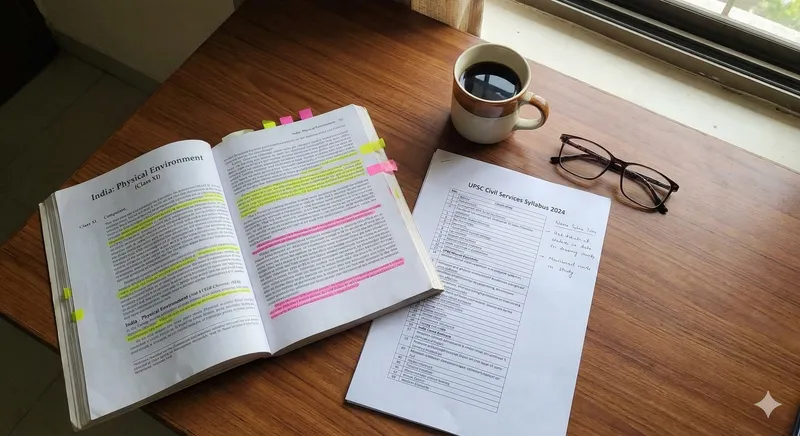

If you have just started your UPSC preparation, looking at a stack of 40+ NCERT books is intimidating. You probably feel like you need to memorize every single page, and after a month of reading, you still struggle to solve basic Previous Year Questions (PYQs). I understand that frustration. In this ultimate guide on how to read ncert for upsc, I will provide insights to navigate these challenges.
Understanding how to read ncert for upsc is crucial for effective preparation.
Knowing how to read ncert for upsc helps you filter and prioritize important information.
In this guide, I will give you a practical, step-by-step framework to read NCERTs like an administrator, not a school student. By the end of this article, you will know exactly how to filter out the noise, extract what matters for the exam, and make highly effective notes.
This comprehensive approach will teach you how to read ncert for upsc efficiently.
Understanding how to read ncert for upsc can dramatically improve your performance.
Once you grasp how to read ncert for upsc, you’ll tackle your revision with confidence.
How to Read NCERT for UPSC: A Comprehensive Approach
This guide will help you master how to read ncert for upsc effectively.
1. The Core Problem: Why You Are Reading NCERTs Wrong
The fundamental mistake most beginners make is the “School Child Mindset.” When an 8th grader reads an NCERT, their goal is to write a 5-mark answer for their school exam. When a UPSC aspirant reads the exact same book, their goal is entirely different. You are reading to understand the socio-economic causes of the 1857 revolt, not just to memorize the date it happened.
Because aspirants lack this clarity, they fall into two traps:
Ultimately, mastering how to read ncert for upsc can lead to better retention of information.
Learning how to read ncert for upsc allows you to connect various concepts effectively.
- Passive Reading: Reading the book like a novel and forgetting it the next day.
- Over-Highlighting: Coloring every single line with a neon marker because “everything seems important.”
If you don’t know the UPSC syllabus and haven’t looked at PYQs, you cannot judge what is important in an NCERT.
Integrate how to read ncert for upsc into your overall preparation strategy.
2. The Core Concepts: Why NCERTs Actually Matter
Before we discuss how to read, you need to understand why UPSC values these books.
Follow the 3-Iteration framework for mastering how to read ncert for upsc.
- Simplicity and Neutrality: NCERTs are published by the government. The data, definitions, and narratives within them are considered the official, neutral stance. This is exactly how your Mains answers should sound.
- Foundation for Heavy Books: If you don’t understand the basic concept of “Inflation” from the Class 11 Macroeconomics NCERT, reading Ramesh Singh or standard economy material will feel like reading Greek.
- Direct Prelims Hits: Every year, 10–15 questions in Prelims (especially in Geography, History, and Art & Culture) are framed directly from the side-boxes and diagrams of NCERTs.
3. Practical Strategy: The 3-Iteration Framework
Do not try to master an NCERT in one sitting. Use the 3-Iteration Framework to build layered understanding.
Iteration 1: The Casual Skim (Focus: Familiarity)
- Goal: Understand the story and basic terminology.
- Action: Read the book chapter by chapter like a storybook. Do not use a pen. Do not highlight. Just get comfortable with the subject matter.
- Timeframe: Fast. A Class 9 History book should take no more than 2–3 days.
Iteration 2: The Analytical Read (Focus: Syllabus Linkage)
- Goal: Filter the content through the lens of UPSC.
- Action: Keep the official UPSC syllabus and a PYQ booklet open next to you. Before reading a chapter, look at the questions asked from that topic in the past 10 years. Now read the chapter actively. Highlight only the keywords, definitions, and concepts that answer those PYQs.
- Timeframe: Moderate. This requires deep focus.
Iteration 3: Extraction and Notes (Focus: Consolidation)
- Goal: Ensure you never have to read the bulky book again.
- Action: Read only your highlighted portions. Transfer these key concepts, flowcharts, and definitions into crisp, digital, or physical notes.
- Rule of Thumb: A 200-page NCERT should be condensed into 10–15 pages of notes.
4. Common Mistakes to Avoid
- Making Notes on the First Reading: This is a fatal error. On your first read, everything looks important. You will end up copying the entire book into your notebook, defeating the purpose of notes entirely.
- Reading Cover-to-Cover Unnecessarily: You do not need to read Class 6 to 12 for every subject. For Polity, Class 11 is crucial, but Class 6 is often too basic for a serious aspirant.
- Ignoring the Maps, Diagrams, and Side-Boxes: UPSC paper setters love the “Did You Know?” side-boxes. Never skip them. Geography diagrams are direct fodder for Mains answers.
Incorporate how to read ncert for upsc into your daily study routines.
5. Realistic Study Framework: Subject-Wise Approach
Different subjects demand different approaches:
- Geography: Read thoroughly from Class 6 to 12. Focus heavily on concepts (monsoon, landforms) and maps. This is the most crucial NCERT segment.
- History: Focus on the timeline, socio-economic conditions, and administrative terms. (e.g., What was a Mansabdar?).
- Polity: Skip the lower classes if you have a basic understanding. Focus intensely on Class 11 (“Indian Constitution at Work” and “Political Theory”).
- Economy: Start directly from Class 9. Focus entirely on conceptual clarity (GDP, Repo Rate, Poverty lines).
- Environment & Science: Focus selectively. For Environment, the last four chapters of the Class 12 Biology NCERT are the holy grail.
6. Resources: Old vs. New NCERTs
This is the most debated topic. Here is the definitive mentor advice:
- History: Read Old NCERTs (RS Sharma for Ancient, Satish Chandra for Medieval, Bipan Chandra for Modern). Why? Because they are written like continuous narratives, making it easier to understand the flow of events.
- Geography, Science, and Economy: Read New NCERTs. Why? Because these subjects require updated data, modern diagrams, and current context.
- Art & Culture: Read the New Class 11 NCERT (“An Introduction to Indian Art”). It is indispensable.
Avoid common pitfalls when learning how to read ncert for upsc.
7. Long-Term Strategy: Bridging NCERTs to Standard Books
Your NCERT preparation does not exist in a vacuum. It is Phase 1 of a 3-Phase strategy.
Once you have completed your NCERT notes (Phase 1), you move to standard reference books (Phase 2). When reading M. Laxmikanth for Polity, use your Class 11 NCERT notes as the foundational base. You will realize that Laxmikanth provides the facts, but the NCERT provided the underlying philosophy of the Constitution. Integrate both into your final revision material (Phase 3).
Conclusion
Mastering NCERTs is not about reading 40 books; it is about developing an administrative mindset. Use the 3-Iteration framework. Let the syllabus guide you, let the PYQs test you, and stop making notes on the first reading. Be disciplined, keep your resources limited, and focus heavily on multiple revisions of your condensed notes.
Focus on how to read ncert for upsc to build a solid foundation.
As you progress, review how to read ncert for upsc to enhance your skills.
Lastly, your ultimate goal should be mastering how to read ncert for upsc.